




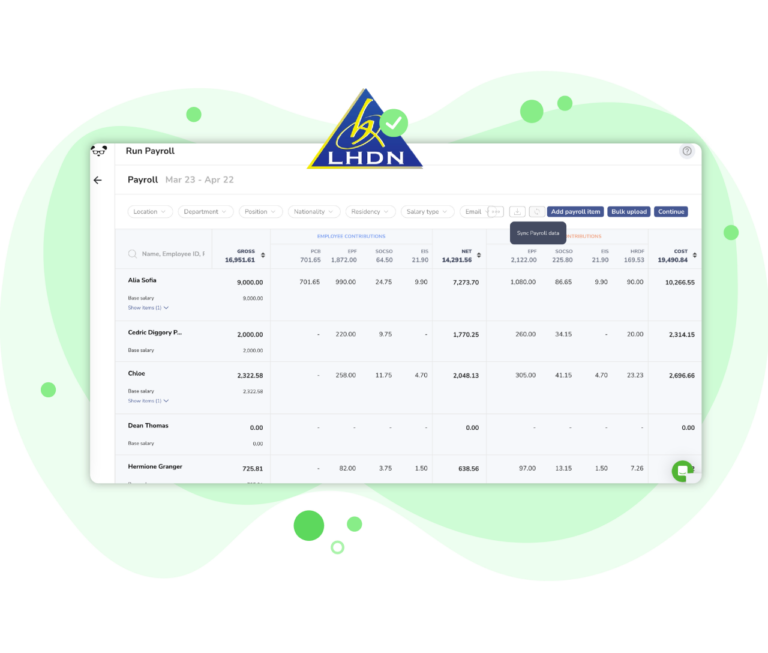
EPF, SOCSO, and EIS contributions are made monthly. Both employees and employers share the contribution, which must be submitted by the 15th of the following month. Failure to do so may result in penalties and legal consequences. Read more about deadlines for EPF, SOCSO & PCB.
Malaysian salary calculators take your gross salary, age group, and residential status to estimate your net pay and statutory contributions. The calculator automatically applies the correct rates so you don’t need to look them up manually.
Many businesses start with spreadsheets, but these become difficult to maintain as your team grows. The most effective way to automate salary calculations is by using payroll software built for Malaysian businesses. PayrollPanda is LHDN-approved and handles EPF, SOCSO, EIS, and PCB calculations automatically, stays up-to-date with the latest Malaysian tax regulations, and generates payslips in one click — no spreadsheets required.
Absolutely! PayrollPanda is built specifically for Malaysian payroll. It handles everything from EPF, SOCSO, and EIS contributions to generating accurate payslips in minutes.
When you see EPF, SOCSO, and EIS broken into two rows, employee and employer, it can be confusing. Here’s the simple breakdown:
- The employee contribution is deducted directly from the employee’s gross salary. This is what reduces their take-home pay.
- The employer contribution is an additional amount paid by the employer on top of the salary. It does not reduce the employee’s take-home pay but adds to the total payroll cost for the business.
For example, for EPF, an employee earning RM5,000 contributes RM550 (11%), while the employer contributes an additional RM650 (13%). The employee takes home RM4,450 (before other deductions), and the business bears a total cost of RM5,650.